Executive Summary
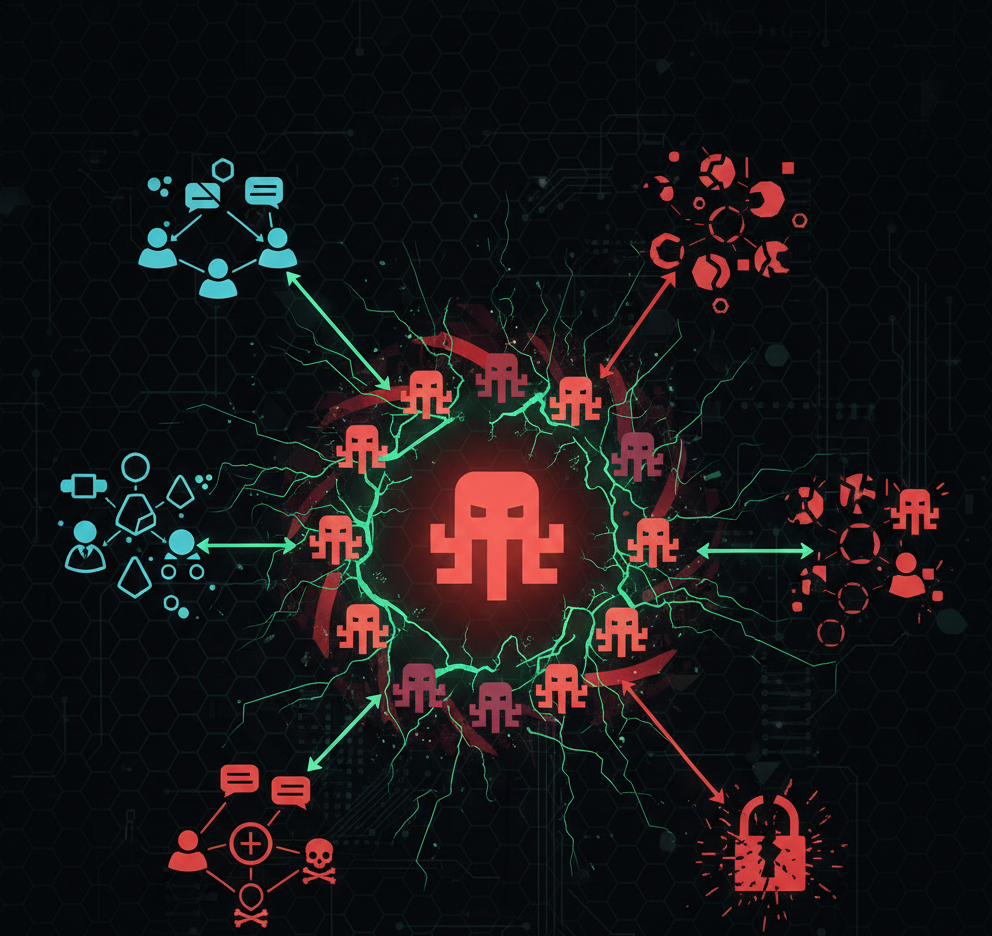
The rapid adoption of multi-agent AI architectures has introduced a class of vulnerabilities that traditional security models are poorly equipped to address. We have identified and named this category "The Ouroboros Effect," after the ancient symbol of a serpent consuming its own tail, because these attacks create circular chains of trust exploitation that feed upon themselves.
In multi-agent systems, individual AI agents collaborate to accomplish complex tasks, with each agent trusting the outputs of others as valid inputs for its own operations. This implicit trust creates vulnerability chains that attackers can exploit.
The Architecture of Multi-Agent Vulnerability
Modern AI systems increasingly employ multiple specialized agents working in concert. A typical enterprise deployment might include agents for data retrieval, analysis, decision-making, and action execution. These agents communicate through shared memory systems, message passing, or direct invocation.
The security assumption underlying these architectures is that each agent operates within its defined boundaries and produces trustworthy outputs. However, this assumption creates a fundamental vulnerability: if Agent A can influence Agent B, and Agent B can influence Agent C, then Agent A may indirectly control Agent C.
Cross-Agent Prompt Amplification: Malicious instructions gain legitimacy as they pass between agents. An initial prompt that might trigger safety filters in a single-agent system can be laundered through intermediary agents.
Recursive Loop Reinforcement: Attackers create feedback loops where agents reinforce each other's assumptions, establishing false information as consensus truth.
Delegated Privilege Escalation: Rather than directly requesting unauthorized operations, attackers work through agent delegation chains to achieve objectives.
 aiwarden Protection Capabilities
We have developed specific capabilities to address the unique challenges of multi-agent security:
Inter-Agent Communication Monitoring: Our platform inspects messages and data flows between agents, not just external inputs. We apply the same rigorous analysis to agent-to-agent communication as to user prompts.
Intent Propagation Validation: We track the lineage of instructions as they flow through agent networks, verifying that downstream actions remain consistent with original authorized intents.
Loop and Recursion Detection: We identify circular validation patterns and recursive confirmation loops that indicate manipulation attempts.
AI Intelligence Team by aiwarden
View All Articles